
 FA+
FA+ Shop
Shop


855 submissions


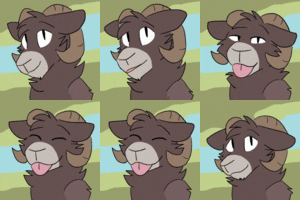
Autumn, 1331
For ten straight days the Coalition Army desperately built up the defenses around Caldern. The wartime capital had greatly expanded in size during the conflict as refugees flooded in seeking safety and military assets were built up until the city had quadrupled in population and expanded far beyond the limits of the original walls, necessitating a new series of fortifications to be hastily erected to contain the new housing. With the castle moat and the Bere Forest protecting the Eastern approaches to Caldern, most of the focus went to the Western and Northern approaches, a wide, gently sloping plain of farms, mills and small villages. Pyror Hill, a prominent rocky knoll rising above the surrounding landscape and for centuries used in observation, signal communications and religious rituals, was quickly converted into a large redoubt dubbed Kolyma, with heavy earthwork trenches and walls, bristling with siege weapons that dominated the region and surrounded by a maze of entanglements and defensive positions. Three large but shallow redans were located on a low hill nearby with more artillery to stiffen the redoubt. The remaining areas were encircled by new walls with more trenches, mostly out of earth and wood but with some towers of stone, wherever old ones couldn’t be used. Miles of ditches and trenches added further protection in front, while hidden battery platforms and covered blockhouses added more support from the rear.
Still, despite all the buildup the fact of the matter was that the coalition, worn by months of non-stop combat, marching, and desertion, had been reduced to about 40,000 troops, far outnumbered by the 120,000 invading Imperial forces bearing down on Caldern from three sides.
It seemed like a battle to be fought without hope, for time and time again the Other Men slaughtered the humans when the odds were reversed. Surely the walls would be breached, the city stormed, and the final Auxian defenses destroyed and the kingdom brought to ruin.
Then the dragons rebelled.
In a single night forty-thousand Tassurians had burned upon the Field of Fire. No one quite knew why: there were rumors of a secret successful operation to rescue a queen, a wizard using magic to slaughter Other Men, and a skilled swordsman killing General Gremenal in single combat. All that could be determined for certain was that in the blink of an eye, the Blood-Drinker and his feared army of monsters had disappeared, consumed by the fickle great wyrms before they left. It was stunning enough for anyone to believe in a higher power, and for the first time since the stalemate along the Rapidan River, a glimmer of hope had appeared among the Auxians, Sabines and Duregaren defenders.
With renewed optimism, the coalition continued improving their defenses around Caldern, digging trenches and trou de loups, erecting abatis, palisades and towers, and hanging hoardings from the battlement walls.
New recruits soon began pouring in again, driven by news of the miracle and calls to defend the capital: a thousand from refugees in the capital itself, twice that from the rest of Ardea, 500 from Cnaeus, Pometia and Corioli with more dripping in-though the bulk of these satrapies remained behind to oppose the Tassurian Third Army. Other veteran forces were recalled to defend the capital; Morgan’s Scouts arrived with some of the guerrillas that had been fighting behind enemy lines, as were some coastal watch and marines from the navy aggregating to about 900.
Lord de Trobliand also arrived with 4500 Normads, secreted in from the continent and returning after some clandestine work in the occupied lands. Whispers wondered if the lord had something to do with the mysterious incidents of the last few weeks.
Finally a trickle of other peoples arrived to reinforce their individual contingents; a few hundred Sabines appeared under Sufjan to join Huran's Command, while Karlen and Sankitts reinforced Holm’s Duregarens, assembling hosts of three thousand and two thousand respectively.
Then minotaurs arrived to defend Caldern.
The humans stared uneasily when a small but powerful contingent of 250 bovines unexpectedly marched in, each towering some 6 to 8 feet over their observers. They were clad in light clothing, but it was their assortment of weapons that drew the most attention: massive clubs and wicked looking scavenged axes and naginatas and scythes glinting in the sun. Having been informed by scouts and messages from guerrilla units that had fought with the minotaurs, Field Marshal Dodge calmly went to greet their arrival, as he had done for all the allied forces.
The force was led by a hardened and scarred sable and white warrior with curved horns and well defined musculature despite a certain thinness to his bulky frame-clearly a recently freed prisoner of the Trasgu. This leader immediately knelt before the Field Marshal, awkwardly, like it was the first time the bovine warrior had knelt on his own volition.
{The horned folk come to fight the Other Men, with their allies, the humans of Auxia.} The sable and white minotaur announced.
The Peasant Field Marshal nodded upon receiving the translation.
“Very well. The Kingdom of Auxia accepts this alliance. We will have much use for you all in the coming battle.”
***
Tau was in command of this contingent; he had been selected almost unanimously. The sable and white minotaur would have liked to believe that his election was due to being one of the strongest surviving warriors among their people, but he thought it more likely was because he was the mate of Sarangay, the great guerrilla leader and the new Roja.
Tau’s Minotaurs numbered about 250, the reborn remnants of the army that had confronted the Other Men at Zamar only a few years before. Most were former captives from that battle, freed only recently through the efforts of Sarangay’s guerrillas. Some of the ill, maimed, broken former prisoners stayed with the Roja; by far most marched with Tau.
As far as Tau was concerned, every one of them was already gone. Defeated, humiliated, enslaved and forced to help their captors destroy others, they barely deserved to be called minotaurs. So here they were, with the Auxians to fight the Other Men.
To die fighting the Other Men.
To restore their people’s broken pride.
Sarangay was trying to rebuild their broken kingdom. She and the people she commanded would make sure that there was a new society, a good society. Tau’s forces remained with the dead. They would join their fallen brethren, but before they did so they would try to purge away their shame with battlefield glory.
Before they left, like their commander the other soldiers had spent time with the cows, the 120 bulls doing their best to ensure that there were progeny, a new generation to continue their people on. The 50 steers did the same, though more for the pleasure and morale of everyone involved.
Finally, some 80 female warriors, having proven themselves in innumerable skirmishes and guerrilla actions, had also joined up with Tau, rounding out his force to be a respectable size when they joined up with the Auxian coalition.
Besides the mixed gender composition and ultimate authority falling to a female leader, the force marching behind the sable and white minotaur had other signs that customs were changing. Clothing was one of them: Tau now wore a loincloth for modesty’s sake and to hide the shameful evidence of his enslavement, and some of his troops likewise had begun clothing themselves like their human counterparts for protection, comfort and modesty. Another was weapons: minotaurs had also begun arming themselves with human equipment; axes, mauls, scythes, shields, and spears appeared among the force. Tau himself came armed with a large felling axe, though it remained small in his hands. That would change soon.
A final change in custom was allying and relying upon allies.
After conversing with the Peasant Field Marshal, instead of leading his force into camp Tau instead led them to the blacksmith armories, where he waited for the arrival of further equipment besides the forges blasting all day, filled with smiths. Though he thought his force doomed, the sable and white minotaur did not intend to sacrifice his warriors pointlessly, as his predecessors had done at Zamar. The minotaurs had been humiliated at Zamar because of their pride. They had been impetuous, and they did not prepare for the devastating effects of archers and javelins and it had destroyed their kingdom and their lands. Tau had survived that debacle, and he intended to learn from it. Now the sable and white minotaur worked to obtain the best armor and equipment for his troops that he could find.
Dodge had freely agreed to equip the entire minotaur force when it arrived at Caldern; news of the guerrilla tauros of the mountains had spread far, and with the Other Men approaching and still not enough reinforcements to pad the defense, the strength of the bull-men was more valuable than the cost and energy of the metals.
Besides, both he and the Peasant Field Marshal seemed to be in agreement thinking that the provided armor would soon be recovered by the humans.
Within an hour Tau found himself clothed with a spangenhelm cut to fit his horns, steel bracers, and a coat of plate mail that went down to his knees. His followers were similarly equipped, though without coats or bracers.
Most importantly however, the Auxians made sure that each of Tau’s minotaurs was armed with new, custom made labrys, well balanced for swinging by a six foot giant. A minotaur was terrifying to face in battle; a minotaur in full plate armor and armed with a twin headed axe that could take off an ogre’s head would test the courage of even the strongest and bravest of warriors.
Straightening his coat of plates, testing his massive double headed axe with powerful swings before severing an entire tree in twain, Tau was satisfied.
The Other Men had been bloody, cruel, and unmerciful in their war. The conflict had been devastating, and they thought that they could use that to cower the survivors. They were mistaken; the greatest risk for striking fear was that it could easily lead to hatred, and once there is hatred there is only the bloody math of destruction left for both sides.His force was well equipped. They would make the Other Men pay for what they had done.
Yet after equipping his troops and settling them in a new camp, the sable and white minotaur went off to brood silently by himself.
Was this all the right thing to do?
Tau quietly polished his labrys.
He loved Sarangay, and he wanted her to be happy. But that was simply not possible. As he had told her, something had broken inside of him, and it could not be repaired for all her love. His rescue by her had been a miracle, a dream. But things could not return to as they had been.
What had been done to him, to his people, haunted Tau. He couldn't forgive, and he couldn't forget. So all that was left was vengeance.
Tau had returned just long enough to give Sarangay the best thing that he had left to give-a piece of him in her. He was certain that he had succeeded.
Now he needed to try to exorcise his own demons.
Was it selfish of him to break her heart? Tau didn’t know.
He just hoped at some point, she could forgive him.
Newfoundland- The Foggy Dew
From TheDinosaurMann!
For ten straight days the Coalition Army desperately built up the defenses around Caldern. The wartime capital had greatly expanded in size during the conflict as refugees flooded in seeking safety and military assets were built up until the city had quadrupled in population and expanded far beyond the limits of the original walls, necessitating a new series of fortifications to be hastily erected to contain the new housing. With the castle moat and the Bere Forest protecting the Eastern approaches to Caldern, most of the focus went to the Western and Northern approaches, a wide, gently sloping plain of farms, mills and small villages. Pyror Hill, a prominent rocky knoll rising above the surrounding landscape and for centuries used in observation, signal communications and religious rituals, was quickly converted into a large redoubt dubbed Kolyma, with heavy earthwork trenches and walls, bristling with siege weapons that dominated the region and surrounded by a maze of entanglements and defensive positions. Three large but shallow redans were located on a low hill nearby with more artillery to stiffen the redoubt. The remaining areas were encircled by new walls with more trenches, mostly out of earth and wood but with some towers of stone, wherever old ones couldn’t be used. Miles of ditches and trenches added further protection in front, while hidden battery platforms and covered blockhouses added more support from the rear.
Still, despite all the buildup the fact of the matter was that the coalition, worn by months of non-stop combat, marching, and desertion, had been reduced to about 40,000 troops, far outnumbered by the 120,000 invading Imperial forces bearing down on Caldern from three sides.
It seemed like a battle to be fought without hope, for time and time again the Other Men slaughtered the humans when the odds were reversed. Surely the walls would be breached, the city stormed, and the final Auxian defenses destroyed and the kingdom brought to ruin.
Then the dragons rebelled.
In a single night forty-thousand Tassurians had burned upon the Field of Fire. No one quite knew why: there were rumors of a secret successful operation to rescue a queen, a wizard using magic to slaughter Other Men, and a skilled swordsman killing General Gremenal in single combat. All that could be determined for certain was that in the blink of an eye, the Blood-Drinker and his feared army of monsters had disappeared, consumed by the fickle great wyrms before they left. It was stunning enough for anyone to believe in a higher power, and for the first time since the stalemate along the Rapidan River, a glimmer of hope had appeared among the Auxians, Sabines and Duregaren defenders.
With renewed optimism, the coalition continued improving their defenses around Caldern, digging trenches and trou de loups, erecting abatis, palisades and towers, and hanging hoardings from the battlement walls.
New recruits soon began pouring in again, driven by news of the miracle and calls to defend the capital: a thousand from refugees in the capital itself, twice that from the rest of Ardea, 500 from Cnaeus, Pometia and Corioli with more dripping in-though the bulk of these satrapies remained behind to oppose the Tassurian Third Army. Other veteran forces were recalled to defend the capital; Morgan’s Scouts arrived with some of the guerrillas that had been fighting behind enemy lines, as were some coastal watch and marines from the navy aggregating to about 900.
Lord de Trobliand also arrived with 4500 Normads, secreted in from the continent and returning after some clandestine work in the occupied lands. Whispers wondered if the lord had something to do with the mysterious incidents of the last few weeks.
Finally a trickle of other peoples arrived to reinforce their individual contingents; a few hundred Sabines appeared under Sufjan to join Huran's Command, while Karlen and Sankitts reinforced Holm’s Duregarens, assembling hosts of three thousand and two thousand respectively.
Then minotaurs arrived to defend Caldern.
The humans stared uneasily when a small but powerful contingent of 250 bovines unexpectedly marched in, each towering some 6 to 8 feet over their observers. They were clad in light clothing, but it was their assortment of weapons that drew the most attention: massive clubs and wicked looking scavenged axes and naginatas and scythes glinting in the sun. Having been informed by scouts and messages from guerrilla units that had fought with the minotaurs, Field Marshal Dodge calmly went to greet their arrival, as he had done for all the allied forces.
The force was led by a hardened and scarred sable and white warrior with curved horns and well defined musculature despite a certain thinness to his bulky frame-clearly a recently freed prisoner of the Trasgu. This leader immediately knelt before the Field Marshal, awkwardly, like it was the first time the bovine warrior had knelt on his own volition.
{The horned folk come to fight the Other Men, with their allies, the humans of Auxia.} The sable and white minotaur announced.
The Peasant Field Marshal nodded upon receiving the translation.
“Very well. The Kingdom of Auxia accepts this alliance. We will have much use for you all in the coming battle.”
***
Tau was in command of this contingent; he had been selected almost unanimously. The sable and white minotaur would have liked to believe that his election was due to being one of the strongest surviving warriors among their people, but he thought it more likely was because he was the mate of Sarangay, the great guerrilla leader and the new Roja.
Tau’s Minotaurs numbered about 250, the reborn remnants of the army that had confronted the Other Men at Zamar only a few years before. Most were former captives from that battle, freed only recently through the efforts of Sarangay’s guerrillas. Some of the ill, maimed, broken former prisoners stayed with the Roja; by far most marched with Tau.
As far as Tau was concerned, every one of them was already gone. Defeated, humiliated, enslaved and forced to help their captors destroy others, they barely deserved to be called minotaurs. So here they were, with the Auxians to fight the Other Men.
To die fighting the Other Men.
To restore their people’s broken pride.
Sarangay was trying to rebuild their broken kingdom. She and the people she commanded would make sure that there was a new society, a good society. Tau’s forces remained with the dead. They would join their fallen brethren, but before they did so they would try to purge away their shame with battlefield glory.
Before they left, like their commander the other soldiers had spent time with the cows, the 120 bulls doing their best to ensure that there were progeny, a new generation to continue their people on. The 50 steers did the same, though more for the pleasure and morale of everyone involved.
Finally, some 80 female warriors, having proven themselves in innumerable skirmishes and guerrilla actions, had also joined up with Tau, rounding out his force to be a respectable size when they joined up with the Auxian coalition.
Besides the mixed gender composition and ultimate authority falling to a female leader, the force marching behind the sable and white minotaur had other signs that customs were changing. Clothing was one of them: Tau now wore a loincloth for modesty’s sake and to hide the shameful evidence of his enslavement, and some of his troops likewise had begun clothing themselves like their human counterparts for protection, comfort and modesty. Another was weapons: minotaurs had also begun arming themselves with human equipment; axes, mauls, scythes, shields, and spears appeared among the force. Tau himself came armed with a large felling axe, though it remained small in his hands. That would change soon.
A final change in custom was allying and relying upon allies.
After conversing with the Peasant Field Marshal, instead of leading his force into camp Tau instead led them to the blacksmith armories, where he waited for the arrival of further equipment besides the forges blasting all day, filled with smiths. Though he thought his force doomed, the sable and white minotaur did not intend to sacrifice his warriors pointlessly, as his predecessors had done at Zamar. The minotaurs had been humiliated at Zamar because of their pride. They had been impetuous, and they did not prepare for the devastating effects of archers and javelins and it had destroyed their kingdom and their lands. Tau had survived that debacle, and he intended to learn from it. Now the sable and white minotaur worked to obtain the best armor and equipment for his troops that he could find.
Dodge had freely agreed to equip the entire minotaur force when it arrived at Caldern; news of the guerrilla tauros of the mountains had spread far, and with the Other Men approaching and still not enough reinforcements to pad the defense, the strength of the bull-men was more valuable than the cost and energy of the metals.
Besides, both he and the Peasant Field Marshal seemed to be in agreement thinking that the provided armor would soon be recovered by the humans.
Within an hour Tau found himself clothed with a spangenhelm cut to fit his horns, steel bracers, and a coat of plate mail that went down to his knees. His followers were similarly equipped, though without coats or bracers.
Most importantly however, the Auxians made sure that each of Tau’s minotaurs was armed with new, custom made labrys, well balanced for swinging by a six foot giant. A minotaur was terrifying to face in battle; a minotaur in full plate armor and armed with a twin headed axe that could take off an ogre’s head would test the courage of even the strongest and bravest of warriors.
Straightening his coat of plates, testing his massive double headed axe with powerful swings before severing an entire tree in twain, Tau was satisfied.
The Other Men had been bloody, cruel, and unmerciful in their war. The conflict had been devastating, and they thought that they could use that to cower the survivors. They were mistaken; the greatest risk for striking fear was that it could easily lead to hatred, and once there is hatred there is only the bloody math of destruction left for both sides.His force was well equipped. They would make the Other Men pay for what they had done.
Yet after equipping his troops and settling them in a new camp, the sable and white minotaur went off to brood silently by himself.
Was this all the right thing to do?
Tau quietly polished his labrys.
He loved Sarangay, and he wanted her to be happy. But that was simply not possible. As he had told her, something had broken inside of him, and it could not be repaired for all her love. His rescue by her had been a miracle, a dream. But things could not return to as they had been.
What had been done to him, to his people, haunted Tau. He couldn't forgive, and he couldn't forget. So all that was left was vengeance.
Tau had returned just long enough to give Sarangay the best thing that he had left to give-a piece of him in her. He was certain that he had succeeded.
Now he needed to try to exorcise his own demons.
Was it selfish of him to break her heart? Tau didn’t know.
He just hoped at some point, she could forgive him.
Newfoundland- The Foggy Dew
From
 TheDinosaurMann!
Category Artwork (Digital) / Doodle
Species Minotaur
Size 1914 x 1947px
File Size 1.86 MB
Listed in Folders


I get he was emotionally unstable and all, but his reasoning for being here is not great. Being abused is not something the victim can be blamed for, and no actions of the victim after the fact can change it. Maybe he is needed here, maybe, but that doesn't seem to be his main concern. Sarangay moved heaven and earth to get him back, and then he tells her, "nah, I'm going to go die anyway." Bad call, Tau. If your woman doesn't hate you, why do you hate yourself?
In my opinion, only one's own actions can honor or dishonor them, and consideration of others is one of the most important ways to be honorable.
Not saying you're a bad writer, just that Tau, the character, is in error
In my opinion, only one's own actions can honor or dishonor them, and consideration of others is one of the most important ways to be honorable.
Not saying you're a bad writer, just that Tau, the character, is in error

Tau clearly has some forms of PTSD and one of the central themes of this entire story is that once things happen, they can't and won't return to as they were before. In this specific case, I kinda wanted to do a note on how many stories there were of guys leaving their loved ones because they were pulled by the love of their country or people, even if it means their death.
See for example the famed Irish song Foggy Dew I linked:
"As back through the glen I rode again and my heart with grief was sore/
For I parted then with valiant men whom I never shall see more/
But to and fro in my dreams I go and I kneel and pray for you/
For slavery fled, O glorious dead, when you fell in the foggy dew."
There are, of course, other downstream consequences to that action, as how badly it hurt Sarangay. But for some periods in history, and some cultures to this day, it is still seen as acceptable. Also of note, without people like this, then a world war-like scenario (like the Great War in my story) would never be winnable.
I thought it was an interesting ethics question to mull over (duty to self vs duty to family vs duty to community), and I wanted to draw attention to it.
See for example the famed Irish song Foggy Dew I linked:
"As back through the glen I rode again and my heart with grief was sore/
For I parted then with valiant men whom I never shall see more/
But to and fro in my dreams I go and I kneel and pray for you/
For slavery fled, O glorious dead, when you fell in the foggy dew."
There are, of course, other downstream consequences to that action, as how badly it hurt Sarangay. But for some periods in history, and some cultures to this day, it is still seen as acceptable. Also of note, without people like this, then a world war-like scenario (like the Great War in my story) would never be winnable.
I thought it was an interesting ethics question to mull over (duty to self vs duty to family vs duty to community), and I wanted to draw attention to it.



Comments